I know that sounds really sappy but, dang it, I think I can allow myself to be a little sappy at least once in my life. And I'm devoting these next few posts to somehow giving you a sense of just how incredible Russia is, so that maybe my sappiness will be a little bit justified.

First things first. This is the Russian flag. It's a good flag to be able to recognize. And, in my opinion, it's really lame and boring. Russia deserves better.
There is one key point about traveling to Russia that I feel like I should mention now, which is that Russia is not a member of the European Union. There are several possible reasons for this. Usually the impression in the West is that Russia is not a member because they are not interested. That was what I had originally thought. But my Russian Literature teacher here pointed out that this may not be true. It may be that, in fact, Russia has not been invited to join, and is therefore using the typical "You don't want me at your party? Fine. ... I didn't want to come anyway" reaction, which is quite sad. Russia is in a similar position to Turkey of being not quite in Europe and not quite in Asia, and of therefore being seen as foreign by both. Europe has always been a bit edgy about Russia, so not inviting Russia to join the EU is very likely.
The point of me mentioning this is that people who are not citizens of the former Soviet republics need a rather expensive and difficult-to-obtain Visa to enter Russia. This is unfortunate because it deters a lot of people, and makes Russia seem very closed-off and even more distant than it really is.
But don't let this put you off and stop you from going to Russia. It's definitely worth the hassle, and anyway the Russian Visa is awesome. I know I'm going to be showing it off to my friends and family when I get back from Denmark (you have been warned).
So. On to the pictures. I'm going to try not to go off on too many tangents and history lectures, but I'm not making any promises.
The flight was a mere two hours from Copenhagen to Saint Petersburg, and we got a nice long, uninterrupted look at the Russian countryside as we prepared to land. The first thing I noticed was that there was snow! Not a ton, admittedly, but for someone who had not seen much snow all winter, it was very exciting.

This was my first look at Saint Petersburg.
When we got off the plane it was chilly, but not cold. And I was too busy quietly freaking out about being in Russia to notice, anyway.
A bit about Saint Petersburg, which was our first stop on the trip. As you can see from the above picture, it is a city on the sea- specifically, the Baltic Sea. It is threaded through by various canals as well as the Neva River, earning it the nickname "Venice of the North". It is a city of many names. From its founding in 1703 until 1914 it was "Saint Petersburg", then at the outbreak of World War I Tsar Nicholas II changed the name to the more Russian-sounding "Petrograd", then after the Revolution the Bolsheviks changed the name to "Leningrad" and finally it became "Saint Petersburg" again after the collapse of the Soviet Union in 1991. It is also now simple referred to as "Peter" by its inhabitants (notably not "Pyotr", which is the Russian equivalent- the use of "Peter" highlights the city's European identity).
The city was Tsar Peter I (the Great)'s big project- that is, apart from building a navy and westernizing the Russians. It was built on land that he had won from Sweden in the Great Northern War in the late 1600s. The land was, in fact, a swamp, and the difficulties of building a city in a swamp are evident by the huge numbers of builders who died- from overworking, injury and disease- during the construction of the city. But it was built anyway, despite the deaths and hardship, as is summed up quite well by the first minute of this video (ooh... technology!): http://www.youtube.com/watch?v=g3YiPC91QUk
Saint Petersburg is described by Pushkin in his poem "The Bronze Horseman" as "a window through to Europe", which was exactly Peter the Great's intention. He was obsessed with Europe and convinced that Russian society needed to mimic European society in order for Russia to advance and develop and be taken seriously by the world. So he built his city in the very outskirts of the Russian empire- as close to Europe as possible- and brought in designers and architects from Italy and Germany to make it truly European in style. All of this was very shocking for the Russians, particularly when Peter the Great made this new, un-Russian, peripheral city into the country's capital, taking the power from Moscow, Russia's ancient cultural center. While the city is not entirely like a European city- because, when it comes down to it it's not European and has a definite Russian feel to it- it is by far the least Russian part of Russia.
Whoo. Sorry. Here, have some pictures.

This was our hotel in Saint Petersburg (called, ironically enough, Moscow Hotel). It's difficult to tell from this picture, but it's HUGE. It looked like an office building and had a small a mall on the first floor. After the collapse of the Soviet Union there was a sudden influx of foreign visitors that Russia was not at all use to or prepared for, so in response they had to quickly build these giant hotels.


One particularly striking aspect of Saint Petersburg are the wonderful pastel-colored buildings. They are not at all what I was expecting, but they give the city a very sunny, almost playful feel. Like someone took a normal 18th century city block and colored it with crayons. As you'll see in a bit, even the state buildings and palaces are colored in this way.
The first afternoon was spent getting us familiar with the functioning of the city and going around to see a few sights. Part of this process was introducing us to the metro.

This is the metro station near our hotel. It was built during the Stalinist era and is typically stylized and cool looking. Allow me to explain...

This is one of the few pictures I have from inside the a Russian metro station, since we were told not to take pictures of them. This is on the escalator going down to the platform in the station pictured above. And, as you can probably already see, this is not your typical metro station. I have never seen centers of public transportation designed with as much style and effort as the ones in Russia. This is because the stations were made to be- as my teacher put it- "palaces for the people". Therefore, they were made to be very grand and aesthetically pleasing. All of the stations in both Saint Petersburg and Moscow were, therefore, really awesome and almost as fun to look at as the historical landmarks and churches and stuff.
Another cool thing about the Saint Petersburg metro is that it is the deepest metro in the world. This is because it had to be built underneath all of the canals and swampy soil and stuff. The escalator ride down to the platform takes, on average, four minutes. Oh, and I think Russian metro escalators cured me of my escalator skittishness. They are ridiculously fast. Any other escalator I take from now on will, I'm sure, seem sluggish in comparison.

Nevsky Prospekt was, awesomely enough, right near our hotel. It is named after the great Russian national hero Aleksandr Nevsky, and it Saint Petersburg's main thoroughfare. Kind of like the Champs-Elysées in Paris. It is a very long boulevard lined with shops that cuts through the city, with the Admiralty building at one end, and has developed a kind of mystical aura over the years, mostly because of stories like Gogol's "Nevsky Prospekt".
In any case, getting to walk down Nevsky Prospekt was a pretty big deal for me, and a must for anyone visiting Saint Petersburg.

Driving down Nevsky Prospekt, on the other hand, is not much fun. Traffic in Russian cities in general is terrible because there are now more cars than the streets were designed to deal with. This is the view out of the front window of our bus when we tried it on our second day in the city.

The Admiralty building at the end of Nevsky Prospekt. It is at the center of the city, showing the importance Peter the Great placed in the navy.

This is a church that we visited called Transfiguration Cathedral. We stopped inside to watch a little bit of the service, but unfortunately I wasn't allowed to take pictures inside. Gold was much in evidence, and the choir was incredible.
I'll wait to give you the lecture on Russian Orthodox Christianity until I get to the post about Novgorod.
At dinner on the first day we got our first experience with Russian food. And yes, I have pictures.

This was our first course, which was mostly different types of salads, as well as salmon, beets and, most notably, reindeer meat, which is that dark thing on the left. It was salty, but good. I will never think about Rudolph the same way again.

Beef stroganov with potatoes. You can't get much more Russian than this, as meat and potatoes are two of the basic staples of Russian food.
By the way, every meal we had contained, at some point, a kind of meat.Vegetarianism doesn't really exist in Russia.

This is something that I had wanted to try, so I was very excited when we had it on the first night. It is blini- Russian pancakes. They usually have stuff in them. These ones were filled with a kind of cream, and were really good.
We got to experience another aspect of Russian food that our teacher had told us about firsthand at breakfast the next day. The hotel offered many different options: yogurt, pancakes, cereal, bread, spaghetti...
Apparently, in Russia there isn't as much of a sense of difference between meals. This comes from a history of having to eat whatever food was available, which would often mean having leftovers from dinner for breakfast.
After having spaghetti for breakfast for about five days in a row, I decided that this was a tradition that needed to come to the United States.
After an awesome breakfast we did some more sightseeing.

This is a statue that was dubbed "the Bronze Horseman" by Pushkin, and the name stuck. It was commissioned by Catherine II and stands near the bank of the Neva river, showing Peter the Great on a horse gesturing grandly into the distance. The horse is usually considered to represent Russia.
This statue is yet another reference to the European nature of Saint Petersburg. There is practically nothing Russian about it. At the time, no other statues like this would have existed in Russia because images of living things were banned by the Church.

This is the inscription on the stone. It says "To Peter I from Catherine II , 1782". And it is in Latin. Latin has never been used in Russia because religious texts were all either in Greek or Church Slavonic, so Latin was never introduced into Russian culture. So putting the inscription in Latin makes it very clear that Catherine II wanted this statue to appear very European.

The sunlight in Russia sure has a flair for the dramatic.

This is the River Neva, which flows through the city and separates it into two parts. Across the river from the Bronze Horseman are many tsarist-era administrative buildings and, most prominently, the Peter and Paul Fortress with the Peter and Paul Cathedral, the spire of which you can see in this picture on the left.
The awesome thing about being in Russia in the spring is that the ice in the rivers is still melting. The Neva was filled with chunks of floating ice, which looked really cool.

Peter and Paul Fortress, which used to be for warding off invaders, then became a prison, and is now just an awesome historical monument.
Okay, here we go. I'm trying something new here. It's a video!

This is Peter and Paul Cathedral, the most famous and, arguably, most important part of Peter and Paul Fortress. It is, like most of the major monuments in Saint Petersburg, very un-Russian, in this case because it has a spire instead of a dome. In fact, they ended up adding a dome on back, as you can see, just to make it slightly less scandalous.
It is one of many cathedrals in Saint Petersburg that no longer functions as an actual church, but has instead become a museum.

Again, note the pastel colors.


One of the coolest things about Peter and Paul Cathedral is that it's where all of the tsars and their immediately families from Peter the Great onward were buried. I ran around like a crazy person trying to take pictures of as many of them as possible, but I'll only show you a select few of the more interesting ones.

First, Peter the Great!

Nicholas I, probably best known for being really reactionary and conservative and for putting down the Decembrist uprising in 1825.

Aleksandr I, during whose reign the Russian army whipped Napoleon's bum in 1812.

Catherine the Great.

Peter III, Catherine the Great's pathetic and rather dumb husband who was very likely the last tsar who was genetically a Romanov.

As you probably know, these guys were executed by the Bolsheviks in the basement of a house in Yekaterinburg (a town in the Ural Mountains) in 1918 and then buried under a road, and all but two bodies were found in the 1970s. They were reburied here in 1998. My Russian history teacher from Mount Holyoke was at the ceremony, in fact, which is pretty cool. The last two bodies- those of Alexey Romanov (the heir) and one of the daughters- were found about two years ago. I'm not sure if they've been put in the box yet. I asked my teacher and he didn't know.
After we left the cathedral we were almost deafened by a canon shot, which is fired from the fortress every day at noon. Fortunately, I took the cue from my teacher and covered my ears in time. Then we went out to look at the river some more, this time from the opposite bank.

Who's that touristy bugger?

There were a bunch of people out sunbathing along the wall in bathing suits. We were all impressed. Yes, it was sunny, but it was still pretty cold.

Look out. Communism ahead!

You were warned.
Here is another of the great statues in Saint Petersburg. It is a statue of Lenin that stands in front of the Finlandskaya train station. The story goes that Lenin arrived in Saint Petersburg by train, walked out of Finlandskaya Station, climbed on top of an armored car and gave a speech that prompted the start of the October Revolution. The armored car that he is represented as standing on in this statue is, obviously, very stylized and abstract, but that's what it is. I had seen pictures of this statue before, but I was surprised by how big it actually is.

Finlandskaya Station.

Unsurprisingly, this metro stop is called Ploshchad Lenina ("Lenin Square").

And then there was lunch. One of the courses was vegetable soup, which seems to be another staple, because we got a lot of vegetable soup in Russia.

Then we went to see one of the places where the writer Fyodor Dostoevsky lived. He lived quite a few places in Saint Petersburg- always in the poorer, more run-down area of the city. This is one of the buildings where he had an apartment.

The plaque that says so.
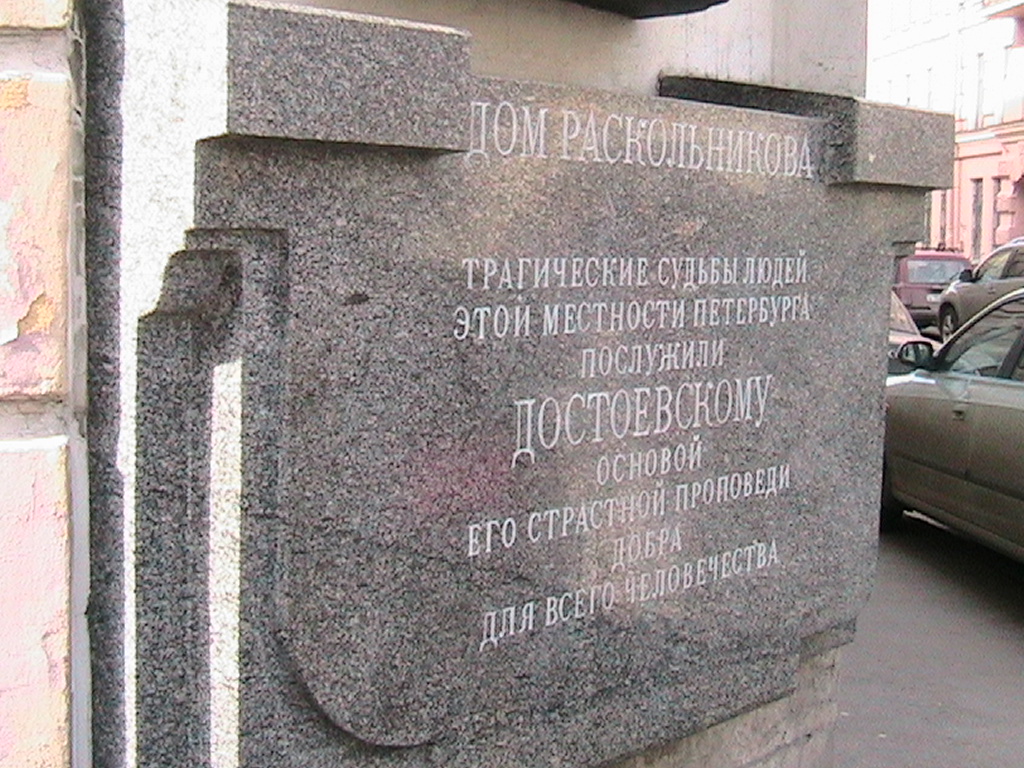
This is a plaque identifying the home of Raskolnikov, the protagonist of "Crime and Punishment" and everyone's favorite fictional axe murderer.

We then followed the path that Raskolnikov took from his home to the building where he committed the murder, which has been identified as this one. I kept catching myself looking around stealthily. I counted 950 steps from one building to the other, whereas Raskolnikov counted 730, but hey, I'm short. That's understandable.

That night we went to see a ballet performance at the Hermitage Theater. The performance was just bits from different ballets, but it was quite entertaining and fun to watch.

A very bouncy ballet video clip.
After going to the ballet we stopped by the Church of the Savior on Spilled Blood. It was cool to see it at night, since we had already seen it- albeit briefly- during the day.

You've probably seen this before. This is the picture that everyone takes when they go to Saint Petersburg.

The church was built between 1883 and 1907 on the spot where Tsar Aleksandr II was blown up by revolutionaries in 1881. It was built to be a fantasy version of a Russian church. It was modeled after Saint Basil's Cathedral in Moscow, which I'll show you later, but the Cathedral on Spilled Blood is actually bigger, which I didn't realized until I actually saw them both.


Wow. This post took a lot longer than I thought it would. I have to go to bed now and I'm going to Greece tomorrow, so I'll stop now and then hopefully get through everything when I get back next weekend.